AR/VR Development Company Dubai: The Complete B2B Guide to Building Immersive Business Solutions in 2026
Key Takeaways
Dubai's AR/VR adoption is now led by real estate, retail, healthcare, hospitality, and logistics, with off-plan property sales as the strongest use case.
Pricing ranges from AED 40,000 for a single AR feature to AED 500,000+ for a full enterprise platform.
The strongest AR/VR solutions integrate cloud infrastructure, AI personalization, and CRM connectivity rather than functioning as a standalone demo.
Choosing a partner with proven industry experience and post-launch support matters more than choosing the most visually impressive demo.
SISGAIN Technologies delivers custom AR/VR solutions for Dubai businesses built to connect directly into existing sales and marketing systems.
Dubai's businesses are done experimenting with AR and VR as side projects. In 2026, immersive technology has moved into the core of how property developers sell apartments, how retailers convert browsers into buyers, and how enterprises train staff without shutting down operations. If you are searching for an AR/VR development company Dubai teams can actually rely on for production-grade work, you already know the market is crowded with agencies that build demo reels but struggle to ship a stable enterprise product.
This guide breaks down what AR, VR, and XR development really involves for a Dubai business, what it costs, which use cases generate the strongest ROI, and how to choose a development partner that understands both the technology and the UAE market.
Quick Answer: An AR/VR development company Dubai businesses can trust combines 3D visualization expertise, mobile and headset development skills, cloud infrastructure for large 3D assets, and AI integration — delivered with post-launch support and UAE data compliance in mind.
Why Dubai Businesses Are Investing in AR/VR Right Now
Dubai's Digital Economy Strategy and the wider push toward becoming a global hub for extended reality (XR) have pushed AR and VR out of the entertainment bucket and into core business infrastructure. Property developers use it to sell off-plan units. Retailers use it to reduce return rates. Hospitals use it for surgical training. Logistics companies use it for warehouse picking and staff onboarding.
Three forces are driving this shift:
Smartphone-based AR has matured. Buyers no longer need a headset to experience AR — a phone camera is enough, which massively lowers the adoption barrier for customer-facing use cases.
Cloud rendering has made VR lighter. Instead of forcing users to download huge 3D files, cloud-based VR streams high-fidelity experiences on demand, which matters for a Dubai audience where international buyers connect from different networks and devices.
AI and AR/VR are converging. Personalization, voice search, and predictive recommendations are being layered onto immersive experiences, so a static 3D tour becomes a live, adaptive sales tool.
Any serious AR/VR development company Dubai clients hire in 2026 needs to be fluent in all three of these shifts, not just the 3D modeling piece.
What Does an AR/VR Development Company Dubai Actually Do?
A lot of business owners assume AR/VR development means building a game-like app with a headset. In practice, the scope is much wider. A capable AR/VR development company Dubai teams partner with typically covers:
3D and Spatial Content Creation
Converting architectural drawings, product CAD files, or physical objects into accurate, interactive 3D models that behave correctly in an immersive environment — correct scale, correct lighting, correct material properties.
Mobile AR Application Development
Building AR features into an existing mobile app or as a standalone app, so a customer can point their phone at a space or product and see an overlay — furniture in a room, a finished apartment in an empty plot, or a machine part in a factory.
VR Headset and Web VR Experiences
Developing walkthroughs and simulations for Meta Quest, Apple Vision Pro, PICO, or browser-based WebXR, depending on whether the use case needs a fully immersive headset experience or a lightweight, shareable link.
Mixed Reality (MR) Solutions
Blending physical and digital environments — useful in showrooms, training centers, and hybrid retail spaces where staff or customers interact with both real and virtual objects at the same time.
Backend, Cloud, and AI Integration
This is the part many agencies underinvest in. A 3D model is only half the product. The other half is the CRM connection, the analytics dashboard, the cloud infrastructure that streams assets to users in Dubai and abroad without lag, and the AI layer that personalizes what each visitor sees.
Industries in Dubai Getting the Most Value From AR/VR
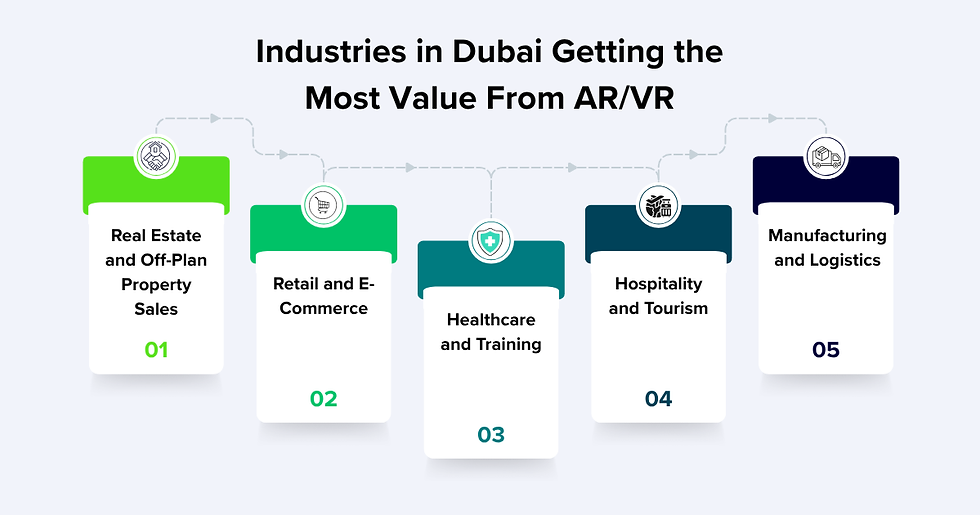
Real Estate and Off-Plan Property Sales
Dubai's off-plan market is the single biggest driver of AR/VR adoption in the region. Buyers — many of them overseas investors — need to make six and seven-figure decisions based on a floor plan and a render. A VR walkthrough of an unbuilt apartment, paired with AR furniture placement, closes that gap. This is one of the fastest-growing verticals for any Real estate app development company Dubai developers partner with, because immersive features now sit inside the same property app buyers already use to browse listings, compare units, and book viewings.
Retail and E-Commerce
Virtual try-on, AR product placement, and 3D product configurators reduce return rates and increase basket size, particularly for furniture, fashion, and electronics brands with a Dubai storefront and an online audience across the GCC.
Healthcare and Training
Surgical simulation, staff onboarding, and equipment training environments let hospitals and clinics reduce training costs while improving safety outcomes, without pulling senior staff away from patient care to supervise every session.
Hospitality and Tourism
Hotel groups and attractions use VR previews and AR wayfinding to market experiences before a guest books, which is particularly effective for Dubai's luxury hospitality segment targeting international travelers.
Manufacturing and Logistics
Warehouse picking guided by AR headsets, remote equipment maintenance using AR overlays, and VR-based safety training are reducing error rates and onboarding time across Dubai's logistics and industrial parks.
Quick Answer: Real estate, retail, healthcare, hospitality, and logistics are the five industries generating the strongest AR/VR ROI in Dubai in 2026, with off-plan property sales leading adoption.
AR vs VR vs XR: A Simple Breakdown for Business Decision-Makers
Business owners often use these terms interchangeably, but the technology choice affects cost, timeline, and user experience.
Technology | What It Does | Best For | Device Needed |
AR (Augmented Reality) | Overlays digital content on the real world | Product visualization, furniture placement, wayfinding | Smartphone or tablet |
VR (Virtual Reality) | Fully replaces the real world with a digital environment | Property walkthroughs, training simulations, virtual showrooms | VR headset or WebXR browser |
MR (Mixed Reality) | Blends digital objects that interact with the real environment | Showroom experiences, technical training, hybrid retail | MR headset (e.g., Vision Pro) |
XR (Extended Reality) | Umbrella term covering AR, VR, and MR | Strategic planning and vendor conversations | N/A |
Understanding this distinction matters when you brief an AR/VR development company Dubai vendors are pitching you — because a vendor who proposes VR headsets for a mass-market retail app is either inexperienced or trying to upsell hardware you don't need.
How the Development Process Works
Step 1: Discovery and Use Case Definition
A good partner starts by asking what business outcome you're chasing — more leads, fewer returns, faster training — not what technology you want. This shapes whether AR, VR, or MR is the right fit.
Step 2: 3D Content Pipeline
Architectural files (BIM/CAD), product photography, or 3D scans are converted into optimized, interactive 3D assets. This step is where quality separates a professional build from a rushed one — poorly optimized models cause lag, especially on mobile devices.
Step 3: Application Development
The AR/VR experience is built as a mobile app, web-based WebXR experience, or headset application, depending on where your audience will actually use it.
Step 4: Backend, CRM, and AI Integration
Lead capture forms, CRM connections, analytics tracking, and AI-based personalization are wired into the experience so it feeds your sales pipeline instead of sitting as an isolated demo.
Step 5: Testing Across Devices
AR/VR experiences need testing across a wide range of phones, browsers, and headsets, because performance varies significantly by device — something that's easy to overlook until users start reporting lag or crashes.
Step 6: Deployment and Post-Launch Support
Cloud hosting, app store submission, and an ongoing maintenance plan for updates, new units or products, and content refreshes.
What Does AR/VR Development Cost in Dubai?
Pricing varies significantly based on scope, but here is a realistic breakdown for Dubai-based projects in 2026:

These figures shift based on how many 3D assets need to be built, whether headset support is required, and how deep the AI personalization layer goes. A transparent AR/VR development company Dubai businesses can trust should walk you through a cost breakdown before you sign anything, not after.
The Technology Stack Behind a Modern AR/VR Solution
BIM/CAD and Architectural Data Import
For real estate and construction use cases, architectural models are imported directly into the immersive environment so the AR/VR experience matches the actual approved design, not an approximation.
3D Modeling and Optimization Engines
Tools like Unity and Unreal Engine remain the backbone for building interactive 3D environments that run smoothly across devices.
AR Object Scanning
Physical products, furniture, or showroom models can be scanned and converted into digital twins, letting a sales team update a "show unit" digitally instead of rebuilding it physically every time a layout changes.
Cloud-Based VR Streaming
Large 3D environments are hosted in the cloud and streamed on demand, which avoids forcing customers to download heavy files — a practical necessity when a chunk of your buyers are connecting from outside the UAE. This kind of infrastructure typically sits on the same Cloud Transformation Services in Dubai foundation that businesses use to modernize the rest of their digital operations, so it pays to plan both together rather than treating them as separate projects.
AI-Powered Personalization
Machine learning models recommend layouts, products, or configurations based on how a user interacts with the AR/VR experience — turning a passive tour into an active sales conversation.
Mobile and Web AR Frameworks
ARKit (iOS) and ARCore (Android) power most consumer-facing AR experiences, while WebXR allows browser-based access with no app download required — an important option for lead-generation campaigns where every extra step reduces conversion.
Why Real Estate Apps and AR/VR Need to Be Built Together
Treating AR/VR as a bolt-on feature separate from your core property or product app is one of the most common mistakes Dubai businesses make. A modern property platform performs best when listings, AI-based recommendations, AR visualization, VR walkthroughs, unit comparison, and lead capture all live inside one connected system rather than as a disconnected microsite that a buyer has to find separately.
This is exactly where a specialized property app development partner adds value — by making sure the AR/VR layer feeds directly into the same CRM, booking flow, and mortgage calculator the rest of the property app already uses, so a sales team never has to manually reconcile leads from two different systems.
Common Challenges Businesses Face When Adopting AR/VR (And How to Avoid Them)
Most AR/VR projects in Dubai don't fail because the technology doesn't work. They fail because of avoidable planning mistakes. Here's what an experienced AR/VR development company Dubai teams should help you sidestep from day one.
Treating AR/VR as a One-Time Marketing Asset
A VR tour built once for a launch event and never updated becomes stale within months, especially in real estate where unit availability, pricing, and finishes change constantly. Budget for ongoing content updates from the start, not as an afterthought.
Underestimating Device Fragmentation
An AR experience that runs smoothly on a flagship iPhone can lag badly on a mid-range Android device — and a large share of your Dubai and GCC audience will be on a mix of devices. Testing across a realistic device spread, not just the latest hardware, prevents a poor first impression for a meaningful chunk of your buyers.
Skipping the CRM Connection
An AR/VR experience that doesn't feed leads into your CRM is a dead end. Every interactive tour, configurator, or walkthrough should capture engagement data and push it into your existing sales pipeline automatically.
Choosing Hardware Before Defining the Use Case
Some businesses commit to VR headsets for a showroom before confirming whether their actual customers will use them. In most consumer-facing Dubai scenarios — property, retail, hospitality — mobile AR delivers a wider reach at a lower cost than headset-based VR. Headsets make more sense for internal training, technical visualization, and premium sales lounges where you control the environment.
Ignoring Load Times for International Users
If a large share of your audience — overseas property investors, for example — connects from outside the UAE, an unoptimized 3D asset that takes 30 seconds to load will lose them before they see anything. Cloud streaming and asset compression need to be planned for from the architecture stage, not patched in later.
Data Security and Compliance Considerations for UAE Businesses
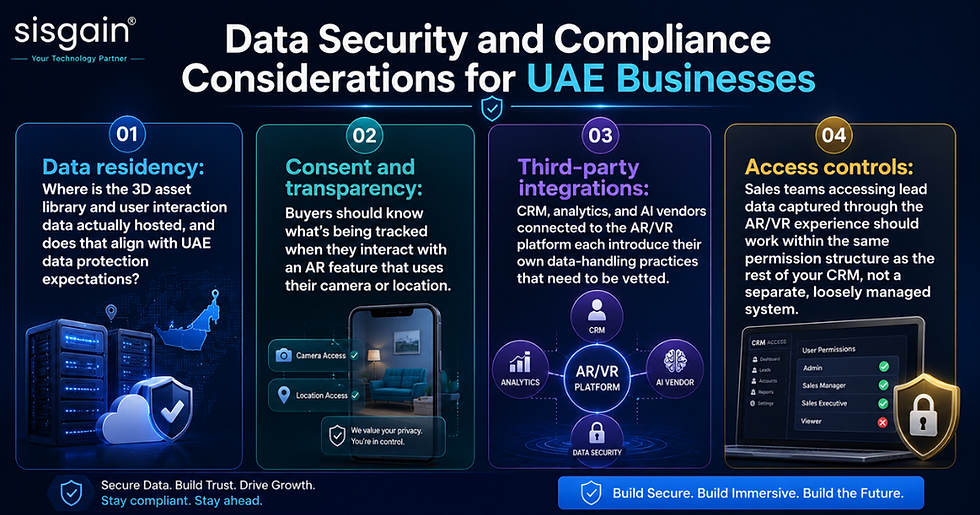
AR/VR platforms often collect more user data than a standard website — device information, spatial interaction patterns, location context for AR features, and behavioral data used for AI personalization. For Dubai businesses, particularly in real estate and healthcare, this raises compliance questions that need to be addressed at the architecture stage:
Data residency: Where is the 3D asset library and user interaction data actually hosted, and does that align with UAE data protection expectations?
Consent and transparency: Buyers should know what's being tracked when they interact with an AR feature that uses their camera or location.
Third-party integrations: CRM, analytics, and AI vendors connected to the AR/VR platform each introduce their own data-handling practices that need to be vetted.
Access controls: Sales teams accessing lead data captured through the AR/VR experience should work within the same permission structure as the rest of your CRM, not a separate, loosely managed system.
A development partner that raises these questions unprompted during the discovery phase is signaling a level of maturity worth paying attention to — it's a strong indicator you're working with an established AR/VR development company Dubai enterprise clients can rely on for sensitive projects, not just a small studio focused purely on visuals.
AR/VR vs Traditional 360° Photography: Which Does Your Business Actually Need?
Not every project needs full interactive AR/VR. Many Dubai businesses start with simpler 360° photography and only move to true immersive development once they've validated demand. Here's how to decide:
Need | Best Fit | Why |
Quick virtual tour of an existing, built space | 360° photography | Fast to produce, no 3D modeling required |
Walkthrough of an unbuilt property | VR (3D-modeled) | No physical space exists yet to photograph |
Letting a customer place a product in their own room | Mobile AR | Requires real-time camera-based overlay, not static imagery |
Customizable unit or product configurations | Interactive 3D/AR | Static photography or 360° tours can't show variant options |
Staff training on equipment or procedures | VR/MR simulation | Needs interactive, repeatable practice scenarios |
Starting with 360° photography for an existing property and layering in true AR/VR for off-plan or configurable inventory is often the most cost-effective sequencing for a growing Dubai business, rather than committing to a full immersive build before you've confirmed customer appetite.
AI + AR/VR: Where Dubai's Market Is Heading in 2026
The next stage beyond a static VR tour is a conversational, AI-driven property or product experience. A buyer types or says "show me a two-bedroom apartment with a sea view under my budget," and the system identifies matching units and launches the relevant AR/VR experience automatically — no manual browsing required.
This convergence depends on clean backend data and workflow automation behind the scenes. Many Dubai enterprises building this kind of AI-driven immersive layer are also investing in business process automation services Dubai providers deliver, because lead qualification, follow-up scheduling, and CRM updates need to happen automatically once a buyer engages with an AR/VR experience — otherwise the immersive front end just creates more manual work for the sales team behind it.
Virtual Show Flats vs Physical Show Apartments
Factor | Physical Show Apartment | AR/VR Show Apartment |
Setup cost | High (construction, furnishing) | Lower, one-time digital build |
Customization | Limited, expensive to change | Highly flexible, update instantly |
Multiple layouts | Difficult, needs separate units | Easy — swap configurations digitally |
Remote/international buyers | Limited access | Full access from anywhere |
Design updates | Expensive rebuild | Digital update, no rebuild |
Scaling across projects | Space-intensive | Multiple projects hosted digitally |
AR/VR doesn't necessarily replace the physical show apartment — in Dubai's luxury segment, buyers still value walking through a real space. What it does is extend that experience to buyers who can't visit in person and lets a sales team demonstrate ten layout variations without building ten physical units.
XR for Luxury Real Estate: Beyond Basic Virtual Tours
For Dubai's high-end developments — branded residences, waterfront villas, mixed-use master communities — XR goes beyond a walkthrough. Developers are using it for:
Interactive master-plan previews showing an entire community before a single tower is built
Branded residence experiences tied to hospitality partners
Virtual sales events for international investor roadshows
Post-sale interior planning tools that let buyers finalize finishes remotely
This is where AR/VR stops being a sales gimmick and becomes a genuine differentiator for a developer's brand positioning.
Modernizing Legacy Systems Before Adding AR/VR
A surprising number of AR/VR projects stall not because of the 3D technology, but because the underlying CRM, booking system, or property management software is outdated and can't handle the data flow an immersive experience generates. Before layering AR/VR onto an existing platform, it's worth assessing whether your core systems need work first. This is a common starting point for businesses that eventually invest in Application Modernization Services in Dubai alongside their immersive technology roadmap, since a modern, API-ready backend makes every AR/VR feature — lead capture, personalization, analytics — significantly easier to build and maintain.
How Developers Can Use AR/VR Across Different Sales Stages
Pre-Launch: Teaser experiences, interactive master plans, early-bird virtual previews for investor lists.
Launch: Virtual show apartments, VR launch events, interactive sales kiosks at property expos.
Sales: AR-based unit customization, remote guided tours, side-by-side unit comparison tools.
Post-Sale: Construction progress visualization, interior finish planning, community amenity previews.
Mapping AR/VR features to each stage of the sales funnel — rather than building one generic "VR tour" and stopping there — is what separates a marketing gimmick from a system that actually moves buyers toward a booking.
What to Look for in an AR/VR Development Company Dubai Businesses Can Trust
Before signing a contract, evaluate a potential partner against these criteria:
Proven experience in your specific industry — real estate, retail, and healthcare AR/VR each require different technical priorities.
In-house 3D and XR development talent, not outsourced freelancers assembled per project.
Cloud infrastructure expertise to handle asset streaming and international user access without lag.
AI integration capability, since personalization is now a baseline expectation, not a bonus feature.
CRM and API integration experience, so the AR/VR layer connects to your existing sales and marketing systems.
Transparent, milestone-based pricing instead of vague estimates.
Post-launch support and content update plans, since AR/VR content needs regular refreshes as your product or property inventory changes.
Data security and compliance awareness relevant to UAE regulations, particularly for real estate and healthcare clients.
A vendor that can speak fluently to all eight points above is functioning as a genuine AR/VR development company Dubai enterprises can build a long-term roadmap with — not just a one-off vendor for a single demo.
In-House Team vs Outsourced AR/VR Development: Which Makes Sense?
Some larger Dubai enterprises consider building an in-house AR/VR team rather than outsourcing. It's worth weighing both paths honestly before committing budget either way.
In-house makes sense when:
AR/VR is core to your product, not a supporting feature (e.g., you're building a proptech platform, not just marketing one property launch).
You expect to release new immersive content weekly or more often.
You already have engineering leadership capable of managing 3D and XR specialists.
Outsourcing to an established AR/VR development company Dubai teams already trust makes sense when:
AR/VR supports a broader business goal — sales, training, marketing — rather than being the product itself.
You need to launch within a defined timeline without a multi-month hiring process for niche 3D and XR talent, which remains scarce in the local market.
You want predictable, milestone-based costs instead of the overhead of a permanent specialized team.
Quick Answer: Most Dubai businesses outside of dedicated proptech or gaming companies get better ROI outsourcing AR/VR development to a specialized partner, reserving in-house hiring for cases where immersive content is a core, continuously updated part of the product.
A hybrid model also works well in practice: outsource the initial build and complex 3D pipeline work to a specialized partner, then bring content updates and minor configuration changes in-house once your internal team has been trained on the platform.
Measuring ROI: What to Track After Launch
Instead of chasing vague claims about AR/VR "increasing sales," track measurable engagement and conversion metrics:
Virtual tour completion rate
Average time spent per unit or product
AR feature usage rate (how many visitors actually activate the AR view)
Lead-to-viewing conversion
Viewing-to-booking conversion
International buyer engagement (a strong signal for real estate specifically)
Most-viewed configurations or layouts, which inform future inventory and marketing decisions
These KPIs give a B2B decision-maker something concrete to report to stakeholders, rather than relying on anecdotal feedback about how "impressive" the demo looked.
A Practical Example: How an AR/VR Rollout Might Look for a Dubai Developer
To make this concrete, here's a realistic sequencing for a mid-size Dubai property developer bringing an off-plan tower to market:
Month 1–2: BIM/CAD architectural files are converted into an optimized 3D model of two representative unit types.
Month 2–3: A mobile AR app is built, letting sales agents show prospective buyers a walkthrough on a tablet during in-person meetings, plus a WebXR version for remote buyers.
Month 3–4: CRM integration is added, so every completed tour and every AR interaction automatically logs a lead with unit preference and engagement time.
Month 4–5: AI-based recommendations go live, suggesting comparable units based on a buyer's browsing behavior inside the tour.
Month 5 onward: Content updates roll out as new floors release, pricing changes, or finish options expand — managed under a monthly retainer rather than a fresh project each time.
This phased approach lets a developer start generating leads from the AR/VR investment within the first quarter, rather than waiting for a fully polished, all-units-included platform before anything goes live.
Future Trends: What's Next for AR/VR in Dubai
Looking beyond 2026, a few shifts are already visible in how Dubai businesses are planning their immersive technology roadmaps:
Spatial computing headsets going mainstream in B2B settings — sales lounges and corporate showrooms adopting devices like Apple Vision Pro for premium client presentations.
Digital twins linked to live construction data, so a VR walkthrough updates automatically as a building progresses, rather than showing a static pre-construction render indefinitely.
Voice-driven AR/VR navigation, letting buyers or customers ask for what they want to see instead of manually navigating menus inside a headset or app.
Cross-platform AR commerce, where a single 3D asset built for a property or product listing is reused across a website, a social media AR filter, and an in-app configurator — instead of being rebuilt for each channel separately.
Businesses that build their AR/VR foundation on flexible cloud infrastructure and clean 3D asset pipelines today will be far better positioned to adopt these shifts without a costly rebuild later.
Why Choose SISGAIN Technologies as Your AR/VR Development Partner
SISGAIN Technologies works with Dubai and UAE businesses that need AR/VR built as a production system, not a proof of concept. Our teams combine 3D and XR development with cloud infrastructure, AI personalization, and backend integration, so the immersive experience you launch connects directly to your CRM, your booking flow, and your sales reporting from day one.
We've supported clients across real estate, retail, and enterprise training with custom AR/VR app development services in Dubai that are built to scale — from a single product visualizer to a multi-unit property platform serving international buyers. Our approach includes milestone-based delivery, transparent cost breakdowns, and a post-launch support plan, so you're not left maintaining a complex 3D system without support once the initial build ships.
If you're evaluating an AR/VR development company Dubai stakeholders will trust with a serious budget and a real business outcome attached, our team is available for a free consultation to scope your project.

Conclusion
AR and VR have moved past the experimental stage for Dubai businesses. Real estate developers are selling apartments before the first brick is laid. Retailers are cutting return rates with virtual try-on. Enterprises are training staff in simulated environments instead of costly physical setups. The businesses winning with this technology in 2026 are the ones treating AR/VR as a connected part of their sales and operations stack — not an isolated demo built once and forgotten.
Choosing the right AR/VR development company Dubai partners can grow with matters more than choosing the flashiest demo reel. Look for a team that understands your industry, builds on solid cloud and AI infrastructure, and stays involved after launch. That's the difference between an AR/VR project that generates leads for years and one that gets quietly retired after six months.
Expert Insight: What Separates a Working AR/VR Product From a Demo
Teams that have shipped AR/VR projects for enterprise clients tend to agree on one thing: the hardest part isn't the 3D visuals — it's everything around them. A demo can look impressive on a conference room screen and still fail in the field if the asset loads slowly on a customer's phone, if the lead never reaches the CRM, or if nobody owns the job of updating content after launch.
The projects that keep generating leads a year after launch are the ones where the development partner planned for maintenance, device fragmentation, and data flow from the first discovery call — not the ones with the most polished opening render. When evaluating proposals, ask a potential partner to walk you through what happens in month six, not just what the demo looks like on launch day. Their answer tells you more about their actual capability than any showreel will.
Frequently Asked Questions
Q1. How much does it cost to hire an AR/VR development company in Dubai?
Costs typically range from AED 40,000 for a single AR product visualizer to AED 500,000+ for a full multi-unit real estate AR/VR platform with CRM integration, depending on scope and complexity.
Q2. How long does it take to build an AR or VR application?
A simple AR mobile experience can take 6–10 weeks, while a full VR property platform with backend integration typically takes 4–6 months.
Q3. Do buyers need a VR headset to experience a virtual property tour?
No. Most Dubai real estate VR tours today are accessible through a web browser (WebXR) or a smartphone, though headset support can be added for showrooms and sales events.
Q4. Can AR/VR be integrated into an existing mobile app?
Yes. AR and VR features can be added as a module inside an existing property, retail, or enterprise app rather than requiring a separate standalone application.
Q5. What industries in Dubai benefit most from AR/VR?
Real estate, retail, healthcare, hospitality, and logistics currently see the strongest returns, with real estate leading due to Dubai's off-plan property market.
Q6. What's the difference between AR and VR for a business use case?
AR overlays digital content onto the real world through a phone or tablet, useful for product visualization. VR fully replaces the environment with a digital one, better suited for immersive walkthroughs and training simulations.
Q7. Can international buyers use AR/VR property tours from outside the UAE?
Yes, provided the experience is cloud-hosted and optimized for remote access, which is a standard requirement for any Dubai developer targeting overseas investors.
Q8. How does AI improve an AR/VR property or product experience?
AI personalizes recommendations, adjusts configurations based on user behavior, and can power conversational search that automatically triggers the right AR/VR experience for a buyer's stated preferences.
Q9. Does an AR/VR development company also handle ongoing content updates?
A reliable partner should offer a maintenance retainer covering new units, products, or configurations added after launch, since 3D content needs regular refreshing.
Q10. How do I choose the right AR/VR development company in Dubai?
Evaluate industry experience, in-house 3D and cloud capability, AI integration skills, CRM/API integration experience, transparent pricing, and post-launch support before signing a contract.


Comments