Blockchain Mobile App Development Dubai: Trends, Market Gaps & Business Opportunities (2026 Guide)

Key Takeaways
Blockchain mobile app development Dubai is being driven by government blockchain initiatives, VARA licensing clarity, and rising enterprise (not just speculative) adoption.
Real estate tokenization and regulated crypto wallets are the two fastest-growing app categories in 2026.
The biggest unmet market gaps are compliance-first architecture, true UAE PASS integration, and Arabic-first UX.
Security fundamentals — key management, smart contract audits, and mobile threat detection — determine long-term trust more than feature count.
Choosing a development partner with real UAE regulatory experience matters more than choosing the cheapest quote.
Dubai doesn't do "wait and see." While most of the world was still debating whether blockchain had a future beyond crypto trading, Dubai's government agencies, banks, and real estate developers were already building on it. That head start is exactly why blockchain mobile app development Dubai has moved from a niche technical service to one of the most in-demand capabilities a UAE business can invest in right now.
This isn't another "blockchain is the future" think piece. It's a practical look at where the market actually stands in 2026 — the trends reshaping mobile blockchain apps, the industries driving demand, the gaps competitors haven't filled yet, and what it actually takes to build something that works inside UAE regulation instead of around it.
Blockchain mobile app development Dubai refers to building smartphone applications that use blockchain infrastructure — smart contracts, tokenization, digital identity, or crypto wallets — tailored to UAE regulatory requirements like VARA licensing, AML/KYC rules, and UAE PASS integration. Demand is being driven by government digitization mandates, real estate tokenization, and fintech's shift from speculative crypto to regulated, enterprise-grade applications.
Why Blockchain Mobile App Development is Growing in Dubai
Three forces are pushing this market forward at once, and none of them are hype-driven.
UAE Government's Blockchain Vision
Dubai set a public target years ago to become one of the first blockchain-powered governments in the world, and the follow-through has been unusually consistent. Land registries, trade licensing, and parts of the judicial system already run partly on distributed ledger infrastructure. When the government itself is the biggest blockchain adopter in the country, every business that touches government services eventually needs software that can talk to that infrastructure.
Digital Economy & Web3 Initiatives
The UAE's push toward a cashless, digitally verified economy didn't stop at payments. Free zones built specifically for virtual assets, sandbox licensing for tokenized securities, and a regulator (VARA) dedicated solely to virtual assets have given founders something most countries still can't offer: a clear legal path to launch. That clarity is why serious capital — not just speculative crypto money — is now funding blockchain app development Dubai projects.
Rising Enterprise Adoption
The conversation inside boardrooms has shifted. Two years ago, "blockchain" mostly meant crypto exchanges. Today, logistics companies want tamper-proof shipment records, banks want faster cross-border settlement, and property developers want fractional ownership platforms. This is enterprise blockchain application development, not speculative token launches — and it's a fundamentally more durable market.
What's changed underneath that shift is risk appetite. Finance and operations teams that once treated blockchain as a side experiment now build it into three-year technology roadmaps alongside cloud migration and AI adoption. Procurement teams issue formal RFPs for blockchain solutions Dubai vendors, complete with security questionnaires and compliance checklists — a level of due diligence that simply didn't exist when this was still a developer curiosity. That maturity is precisely why the businesses moving first are locking in a durable advantage rather than chasing a short-lived trend.
Latest Trends in Blockchain Mobile App Development Dubai (2026)

Tokenized Real Estate Platforms
Real estate tokenization Dubai has gone from concept to functioning product category. Developers are splitting high-value property into digital shares, letting investors buy fractional ownership through a mobile app instead of needing full capital for a unit. Secondary trading marketplaces are emerging too, giving token holders liquidity that traditional property investment never offered. If there's one trend defining blockchain in mobile app development in Dubai right now, this is it.
The mechanics matter here. A well-built tokenized property app has to handle title registration in sync with the Dubai Land Department's own digital records, manage rental income distribution proportional to token ownership, and support secondary trading without creating regulatory exposure under securities law. Get any one of those wrong, and the app either can't scale past a pilot or draws the wrong kind of regulatory attention. That's a very different engineering brief from a typical consumer app, and it's why generic development shops tend to underestimate the timeline and budget for this category.
Regulated Crypto & Digital Asset Apps
The "wild west" phase of crypto apps is over in this market. VARA-licensed exchanges, multi-asset wallets built for compliance from day one, and apps designed around transaction monitoring rather than anonymity are what's actually getting funded and approved. A blockchain wallet app development project here has to assume regulatory scrutiny from the first line of code, not retrofit it later.
UAE PASS & Digital Identity Integration
Any mobile blockchain app that expects UAE users to trust it with financial or identity data increasingly needs to plug into UAE PASS — the national digital identity system. Biometric onboarding, instant identity verification, and eKYC flows tied to UAE PASS cut onboarding friction dramatically and signal to users that the app is operating within the country's official digital trust framework, not outside it.
UAE PASS integration matters because it lets blockchain apps verify a user's identity against a government-issued digital ID in seconds, replacing manual document uploads with biometric or single sign-on verification — a near-mandatory expectation for any serious blockchain fintech app development project in the UAE today.
Enterprise Blockchain Applications
Away from consumer apps, the quieter but larger growth area is enterprise use: supply chain tracking that timestamps every handoff, government record systems that make forged documents nearly impossible, cross-border payment rails that settle in minutes instead of days, and digital document verification for contracts, certificates, and trade paperwork. This is where enterprise blockchain app development earns its keep — not through flashy consumer features, but through quietly removing entire categories of fraud and reconciliation work.
Many of these organizations start the process by bringing in blockchain consulting Dubai specialists to map which internal processes actually benefit from a distributed ledger versus which ones simply need a better traditional database. That distinction saves significant budget before a single line of code gets written, since not every workflow needs blockchain — some just need it because a competitor mentioned it in a pitch deck.
Industries Driving Blockchain Mobile App Development in Dubai
Fintech & Digital Banking — Neobanks and payment platforms are using blockchain rails for instant settlement and building distributed-ledger capability directly into their core product, not as an add-on feature. Remittance corridors between the UAE and South Asia, in particular, are seeing real experimentation with blockchain-based settlement to cut both cost and transfer time.
Real Estate Tokenization — Beyond fractional ownership, developers are using tokenization for smart-contract-based rental agreements and automated escrow release, removing the manual reconciliation that traditionally slows down UAE property transactions.
Logistics & Supply Chain — Freight forwarders and 3PL companies use blockchain to create an unchangeable record of custody, especially valuable for high-value or regulated goods moving through Jebel Ali and other UAE trade hubs. Customs documentation, in particular, benefits from a shared ledger that every party in the chain — shipper, carrier, and regulator — can trust without needing to reconcile separate paper trails.
Government Digital Services — Licensing, permits, and public records benefit from tamper-evident storage and instant verification, an area closely tied to broader Government Software Development initiatives already underway across emirates, and increasingly delivered through specialist blockchain software development Dubai teams rather than general IT contractors.
Healthcare — Patient consent records, prescription verification, and cross-facility data sharing are early but growing use cases, particularly where data integrity is legally sensitive.
Retail, Hospitality & Loyalty Platforms — Token-based loyalty points that customers can trade or redeem across partner brands are appearing in UAE malls and hotel groups looking to differentiate their rewards programs.
Market Gaps Creating New Business Opportunities
This is the part most "trend" articles skip, and it's the most useful part for anyone actually deciding whether to invest.
Compliance-First Blockchain Apps
Most blockchain apps are still designed crypto-first and compliance-second. In the UAE, that order needs to flip. There's real opportunity for blockchain mobile app development Dubai providers who build AML/KYC, transaction monitoring, and VARA reporting into the architecture from day one rather than bolting it on after a regulator flags a gap.
UAE PASS Integration
Surprisingly few blockchain apps in the market have genuinely seamless UAE PASS integration — most still rely on manual KYC uploads. Whoever solves this cleanly earns a real onboarding advantage.
Arabic-First Mobile UX
A large share of blockchain apps serving the UAE are still English-first with an Arabic translation layered on top. True Arabic-first design — right-to-left layouts, culturally appropriate terminology for financial products, local number formatting — remains underserved.
Blockchain Security & Wallet Protection
Wallet-draining scams and phishing attacks targeting crypto users haven't slowed down. Apps that visibly invest in multi-signature wallets, biometric transaction approval, and real-time fraud detection build the kind of trust that converts cautious UAE consumers into active users.
Industry-Specific Blockchain Solutions
Generic "blockchain app builder" templates don't hold up in specialized industries. Logistics companies need custom chain-of-custody logic; real estate firms need tokenization models that match UAE property law; healthcare needs consent frameworks that satisfy Dubai Health Authority requirements. Off-the-shelf platforms rarely get this right.
The biggest market gap in blockchain mobile app development Dubai right now isn't technology — it's compliance-native design combined with genuinely local UX (Arabic-first interfaces, UAE PASS integration, and industry-specific logic) rather than generic global templates adapted after the fact.
Best Blockchain Mobile App Ideas for UAE Businesses
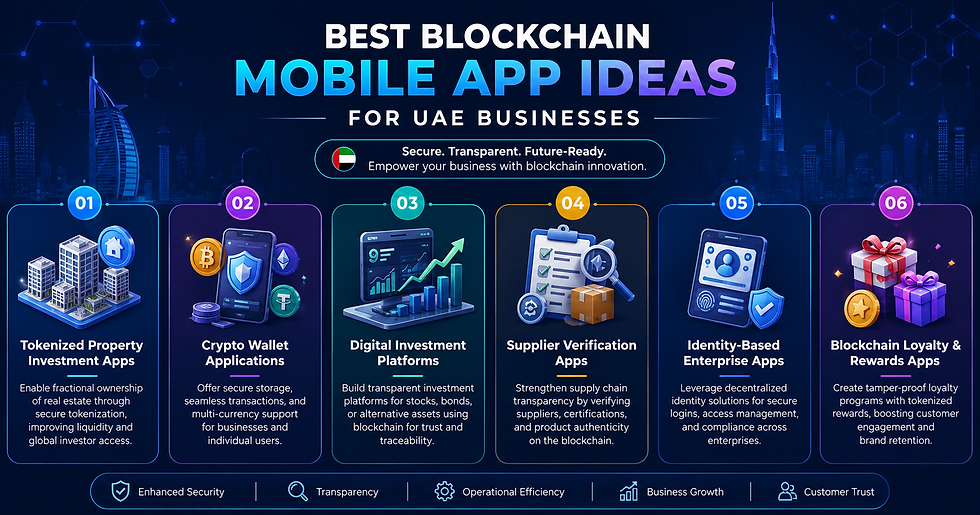
If you're weighing where to put development budget, these are the categories showing the strongest traction:
Tokenized Property Investment Apps — fractional real estate ownership with in-app secondary trading, usually paired with smart contract development Dubai teams have already tested against local property law
Crypto Wallet Applications — multi-asset, VARA-compliant wallets with biometric security
Digital Investment Platforms — tokenized bonds, funds, or commodities aimed at retail and accredited investors, often built on a broader tokenization platform development foundation that can support multiple asset classes over time
Supplier Verification Apps — blockchain-backed vendor and product authenticity checks for logistics and retail supply chains
Identity-Based Enterprise Apps — internal workforce or contractor verification tools built on decentralized identity
Blockchain Loyalty & Rewards Apps — tradeable, cross-brand loyalty tokens for retail and hospitality groups
What UAE Businesses Expect from a Blockchain Mobile App
Speaking with enterprise clients across these verticals surfaces the same short list of expectations, again and again:
Faster User Onboarding — no ten-minute document upload flows
Regulatory Compliance — VARA, AML, and central bank alignment built in, not bolted on
Secure Digital Wallets — with clear recovery options, not just a seed phrase and a prayer
Biometric Authentication — fingerprint or face ID as the default, not an afterthought
UAE PASS Integration — for instant, government-grade identity checks
Local Payment Gateway Support — working smoothly with UAE bank rails and card networks
Scalable Enterprise Architecture — able to handle transaction volume growth without a rebuild eighteen months in
Essential Features of a Modern Blockchain Mobile App
A serious mobile blockchain app development build in this market typically needs:
Secure authentication, smart contracts for automated agreement execution, integrated wallets, asset tokenization capability, multi-currency support (fiat and digital assets side by side), real-time push notifications for transactions, digital identity verification, QR-based payments, built-in AML/KYC modules, immutable audit logs for every transaction, cloud-based scalability, and an analytics dashboard for both users and administrators.
Skipping any one of these isn't necessarily fatal at launch — but it's almost always the first thing a regulator, investor, or security auditor asks about six months later.
Compliance & Security Considerations in Dubai

This is where most blockchain projects either earn long-term trust or quietly fail.
AML & KYC Readiness — Transaction monitoring thresholds and suspicious activity reporting need to be designed in, not patched in after a VARA review.
Identity Verification — Beyond basic KYC, apps handling higher transaction values need tiered verification that scales with risk.
Secure Key Management — How private keys are generated, stored, and recovered is often the single biggest technical decision in the entire build — get it wrong and no amount of UX polish saves the app.
Smart Contract Audits — Every contract governing money movement or asset ownership should go through independent audit before mainnet deployment. This isn't optional in a regulated market.
Mobile Threat Detection — Root/jailbreak detection, anti-tampering, and runtime application self-protection matter more for financial and blockchain apps than almost any other mobile category.
Regulatory Documentation — VARA and other UAE regulators expect clear technical documentation on data flows, custody models, and risk controls — not just a working app.
Taken together, these six areas explain why so many blockchain projects stall between MVP and full launch in this market. A prototype can ignore all of them and still demo well. A production app serving real UAE customers with real money cannot. Teams that treat compliance and security as parallel workstreams from day one — rather than a checklist to satisfy right before launch — consistently ship faster in the end, because they aren't rebuilding core architecture six weeks before a regulatory review.
How to Choose the Right Blockchain Mobile App Development Company in Dubai
Not every developer who's built a token contract can build a compliant, enterprise-grade blockchain mobile app development Dubai project. There's a real difference between a freelance team offering custom blockchain app development on the side and an established blockchain development company Dubai businesses can rely on for a multi-year product roadmap. Look for:
UAE Regulatory Experience — Has the team actually shipped something through VARA licensing or worked alongside UAE legal counsel, or is this their first attempt at understanding local rules?
Smart Contract Expertise — Ask to see audited contracts they've written, not just a GitHub link.
Mobile Development Capabilities — Blockchain knowledge without strong native or cross-platform mobile engineering produces apps that are secure but unpleasant to use.
Security & Compliance — Confirm they build AML/KYC and audit logging as standard practice, not a paid add-on.
Industry Portfolio — A team that's built for real estate tokenization understands that space very differently from one that's only built crypto wallets.
Post-Launch Support — Blockchain apps need ongoing smart contract monitoring and regulatory updates long after launch, so ask what support looks like at month six and month twelve, not just at go-live.
Working with an experienced blockchain app development company that has actually operated inside these constraints — rather than one adapting a generic global playbook to Dubai after the fact — tends to be the difference between a smooth VARA review and a costly redesign.
Future of Blockchain Mobile App Development in Dubai
A few directions are already visible on the horizon:
Real World Asset (RWA) Tokenization expanding well beyond real estate into commodities, invoices, and private equity
Government Blockchain Infrastructure deepening across more emirates and service categories
AI + Blockchain Integration — using AI Blockchain Integration to power fraud detection, smart contract risk scoring, and predictive compliance monitoring on top of blockchain's tamper-proof data layer
CBDCs — central bank digital currency pilots that will eventually need consumer and enterprise-facing mobile interfaces
Enterprise Web3 adoption moving from pilot projects to standard operating infrastructure
Decentralized Identity reducing reliance on centralized KYC databases
Cross-border Finance — blockchain-powered settlement between UAE and its major trading partners
Why Businesses Should Invest Now
The UAE's regulatory maturity is a genuine first-mover advantage that's rare in this industry globally — most markets are still figuring out basic legal frameworks for digital assets while Dubai already has working licensing regimes. Enterprise demand is growing month over month, government support isn't slowing down, and investor confidence in properly compliant blockchain projects is climbing even as speculative crypto interest cools elsewhere. Businesses that build now, on solid compliance foundations, are positioning themselves ahead of a wave of competitors who will eventually have to catch up.
Why Choose SISGAIN TECHNOLOGIES
SISGAIN TECHNOLOGIES builds blockchain mobile apps for the market conditions that actually exist in Dubai today — not a generic global template with a local logo swapped in. As a UAE blockchain development company, the team designs for VARA compliance and AML/KYC requirements from the first architecture decision, integrates UAE PASS for identity verification, and has direct experience across the industries driving this market: real estate tokenization, fintech wallets, logistics verification, and government-adjacent digital services.
In-house blockchain developers Dubai clients work with directly — rather than an offshore team several time zones away — makes a measurable difference during regulatory review cycles, when quick clarifications and same-day fixes matter far more than a lower hourly rate. Whether the requirement is a full blockchain app development company UAE partnership or targeted blockchain development services Dubai for one specific module, the same compliance-first process applies.
As a full-stack mobile app development company Dubai businesses turn to, SISGAIN combines blockchain engineering with native mobile expertise, security-first key management, and smart contract audit practices — so the apps it delivers are built to pass regulatory review the first time, not the third.

Conclusion
Dubai's blockchain story has moved past speculation. The government has built the legal and technical scaffolding, enterprises across fintech, real estate, logistics, and government services are actively adopting it, and the businesses investing in blockchain mobile app development Dubai today are positioning themselves for a market that's only getting more regulated, more serious, and more valuable. The opportunity now sits with compliance-ready, secure, and genuinely locally-built solutions — not the fastest MVP, but the most trustworthy one. The future belongs to regulated fintech, tokenized real-world assets, digital identity infrastructure, and enterprise blockchain applications built to last.
Frequently Asked Questions
What is blockchain mobile app development?
It's the process of building smartphone applications that run on or interact with blockchain networks — using features like smart contracts, tokenization, and crypto wallets instead of traditional centralized databases.
Why is blockchain mobile app development growing in Dubai?
Government-led blockchain adoption, dedicated virtual asset regulation (VARA), and rising enterprise demand across fintech, real estate, and logistics are all converging at once.
How much does blockchain mobile app development cost in Dubai?
Costs vary widely based on complexity — a basic wallet app costs far less than a tokenized real estate platform with smart contract audits, AML/KYC modules, and UAE PASS integration. Getting a scoped quote based on your specific feature list is the only reliable way to budget accurately.
Which industries benefit most from blockchain mobile apps?
Fintech, real estate, logistics, government services, and increasingly healthcare and retail loyalty programs are seeing the strongest returns from blockchain mobile app development.
What is the role of UAE PASS in blockchain mobile apps?
UAE PASS provides government-verified digital identity, letting blockchain apps confirm a user's identity instantly through biometrics or single sign-on rather than manual document review.
Are blockchain mobile apps legal in Dubai?
Yes, provided they comply with UAE regulations, including VARA licensing for virtual asset activities and applicable AML/KYC requirements — this is precisely why compliance-first development matters so much in this market.
How secure are blockchain mobile applications?
Security depends heavily on execution — proper key management, audited smart contracts, and mobile threat detection make a substantial difference between a genuinely secure app and one that only appears secure.
How long does it take to build a blockchain mobile app?
Timelines typically range from a few months for a straightforward wallet app to closer to a year for a fully compliant, audited tokenization or enterprise platform.
What features should a blockchain wallet app include?
Multi-currency support, biometric authentication, secure key management, transaction notifications, and AML/KYC compliance modules are the baseline expectations for a serious crypto wallet build today.
How do I choose a blockchain app development company in Dubai?
Prioritize proven UAE regulatory experience, verifiable smart contract audit history, strong native mobile engineering, and a track record of post-launch support — not just the lowest quote.


Comments