How AI Helps Mining Companies Automate and Optimize Operations

Key Takeaways
Mining software solutions combine AI, IoT, and automation to optimize every stage of mining, from exploration to processing.
Predictive maintenance, autonomous fleet management, and digital twins are already delivering measurable uptime and cost improvements.
The global AI-in-mining market is projected to reach roughly USD 8.2 billion by 2030, growing at about 14.2 percent annually.
Integrated ERP-style platforms turn disconnected data into a single, real-time source of truth for production, safety, and finance.
Choosing an experienced mining-focused software partner is the single biggest factor in whether AI adoption delivers real ROI.
Mining has never been an easy business. Deep ore bodies, unpredictable geology, expensive equipment, and workforce safety risks have always made margins hard to protect. Now add rising energy costs, tighter environmental regulation, and a global race for critical minerals, and it's clear why traditional, spreadsheet-driven mine management can no longer keep up.
This is exactly where mining software solutions are changing the game. Across the UAE, mining and minerals companies are moving away from manual planning, paper-based maintenance logs, and disconnected equipment data — and moving toward AI-powered platforms that plan, predict, and optimize operations in real time.
The result isn't just efficiency. It's safer sites, lower costs, and mines that can finally make decisions at the speed the market demands.
In this guide, we'll break down exactly how AI is automating and optimizing mining operations today, what a modern mining software stack actually includes, and how UAE mining companies can choose the right technology partner to make the shift without disrupting production. If you're evaluating Mining Software Solutions Dubai vendors for the first time, this breakdown will also give you a clear framework for what "good" actually looks like.
Mining software solutions use AI, IoT sensors, and automation to plan, monitor, and optimize every stage of mining — from exploration and fleet management to processing and safety — reducing downtime, cutting costs, and improving decision-making accuracy.
Why UAE Mining Companies Need Digital Transformation Now
The UAE's push to diversify beyond oil and gas has put mining and minerals squarely on the national agenda. Investment entities based in Dubai and Abu Dhabi are backing mineral exploration and processing projects both within the region and across Africa and Central Asia, and that capital comes with an expectation of measurable, data-backed performance — not gut-feel decision-making.
At the same time, mining operations everywhere are dealing with the same structural pressures: aging equipment fleets, a shrinking pool of experienced operators, volatile energy costs, and safety mandates that leave zero room for error. Manual processes simply can't keep pace with all of this at once. A maintenance schedule built on fixed intervals rather than real equipment condition either wastes money on unnecessary servicing or risks a costly breakdown. A production plan built on last month's numbers can't react to today's ore variability or market shift.
Mining Industry Software Solutions close this gap by connecting geological data, equipment sensors, production schedules, and financial systems into one platform that updates in real time. For a UAE mining investor or operator, that means faster, more confident decisions — and a competitive edge over operations still running on legacy tools.
There's also a talent dimension to this shift that's easy to underestimate. The mining sector globally is losing experienced professionals to retirement faster than it's replacing them, and this gap is felt acutely in newer mining markets where local expertise is still being built up. AI-powered systems that capture operational knowledge, standardize best practices, and support remote monitoring from centralized operations centers help bridge exactly this kind of gap — letting a smaller pool of experienced staff effectively oversee more sites and more equipment than would otherwise be possible. For UAE mining ventures scaling operations across multiple regions, that capability isn't a nice-to-have; it's often the difference between a growth plan that's operationally realistic and one that isn't.
UAE mining companies need digital transformation because rising costs, safety regulations, and workforce shortages make manual, disconnected operations too slow and too risky to remain competitive.
What Are Mining Software Solutions?
At their core, mining software solutions are digital platforms built specifically to plan, run, and optimize mining operations — from the moment a geological survey is completed to the day ore is processed and shipped. Unlike generic enterprise software, these platforms are designed around the realities of mining: remote sites, heavy equipment, hazardous environments, and constantly shifting geological conditions. A trusted software development company in Dubai can build customized mining software that addresses these industry-specific challenges while ensuring scalability, security, and seamless integration with existing systems.
A modern mining software solution typically combines several layers of technology working together: a data layer that pulls in information from drill logs, sensors, and equipment telemetry; an AI and analytics layer that turns that data into predictions and recommendations; and an operations layer where planners, engineers, and safety teams act on those insights through dashboards, alerts, and automated workflows.
What makes today's platforms genuinely different from the mine-planning software of a decade ago is the AI layer itself. Instead of simply storing and displaying data, machine learning models now forecast equipment failures before they happen, recommend the most efficient haul routes in real time, and flag safety risks the moment sensor patterns start to look abnormal.
It's worth being clear about what these platforms are not. They're not a replacement for experienced mining engineers, geologists, or safety officers—they're a decision-support layer that removes hours of manual data crunching so that expertise can be applied faster and with better information. That's why many organizations choose to partner with a software development company in Dubai that specializes in AI-powered industrial solutions, ensuring the technology enhances human expertise rather than replacing it. The best implementations treat AI as an amplifier for human judgment, not a substitute for it, which is also why change management and training matter just as much as the underlying technology.

Core AI Applications Transforming Mining Operations
Understanding the theory is one thing — seeing where AI actually plugs into daily mining operations is what makes the technology worth the investment. Here's where it's delivering results right now.
Predictive Maintenance That Prevents Costly Downtime
Unplanned equipment failure is one of the most expensive problems in mining. A single haul truck or crusher going down mid-shift can halt production for hours and cost far more than the repair itself.
AI-based predictive maintenance systems continuously analyze vibration, temperature, and pressure data from equipment sensors to detect early warning signs of wear — often weeks before a traditional inspection would catch them.
Instead of servicing machinery on a fixed calendar, teams can now act on actual equipment condition. Industry data shows that mining operations using predictive maintenance are seeing significantly higher equipment uptime and lower unplanned downtime compared to sites still relying on reactive or scheduled maintenance alone.
The shift here is really from calendar-based thinking to condition-based thinking. A crusher that runs harder during a high-throughput week wears differently than one running at reduced capacity, yet a fixed maintenance calendar treats them identically. AI models trained on historical failure patterns learn the specific signatures that precede a bearing failure, a hydraulic leak, or a motor overload for each individual machine — not a generic equipment class. Over time, this means maintenance teams stop guessing and start acting on ranked, prioritized alerts: which machine needs attention this week, which can safely wait another month, and which is showing an early anomaly worth a closer look before it becomes a five-figure repair.
Autonomous Fleet and Equipment Management
Haul trucks, drills, and loaders account for a huge share of operating costs, and coordinating them manually across a large site is inefficient at best. AI-powered fleet management systems now use GPS, radar, and machine learning to route vehicles automatically, balance loads across the fleet, and adjust schedules in real time based on weather, equipment availability, and production targets.
This isn't limited to fully autonomous vehicles either — even semi-automated dispatch systems that optimize routes and reduce idle time deliver a measurable fuel and productivity benefit. For UAE-based operators managing sites across multiple regions, this kind of centralized, AI-driven coordination also means head-office teams can monitor and adjust fleet performance without being physically on-site.
Consider a haul route between a pit and a processing plant. A manually planned route might stay fixed for weeks regardless of changing pit geometry or weather-related surface conditions. An AI-optimized system continuously recalculates the most efficient path based on live grade control data, truck payload, tire wear, and even ambient temperature — since equipment efficiency in extreme heat, a genuinely relevant factor for UAE and Gulf-region operations, behaves differently than in temperate climates. Small routing gains compound quickly across a fleet running 24 hours a day, translating into real fuel savings and additional tonnes moved per shift without adding a single truck to the fleet.
AI-driven fleet management continuously recalculates optimal routes and equipment loads based on real-time site conditions, reducing fuel use and increasing tonnes moved per shift.
AI-Driven Exploration and Geological Modeling
Exploration has traditionally been slow, expensive, and heavily dependent on experienced geologists interpreting drill and survey data by hand. AI models now analyze geological, geophysical, and satellite data simultaneously, identifying mineralization patterns far faster than manual review — in some cases cutting discovery timelines by 20 to 30 percent.
As new drilling results come in, these models update automatically, so mine plans always reflect the latest understanding of the ore body rather than an outdated static model. For investors evaluating new mineral opportunities, this translates directly into faster, better-informed decisions about where to commit capital.
This matters especially for UAE-based mining investment entities that evaluate opportunities across multiple jurisdictions simultaneously. Instead of waiting weeks for a geological consultancy to manually process drill results from three different projects, AI-assisted modeling can process and cross-compare that data in days, giving decision-makers a much faster read on which project deserves the next round of capital. It doesn't replace the geologist's judgment — it simply removes the weeks of manual pattern-matching that used to stand between raw data and an informed decision.
Digital Twins for Smarter Mine Planning
A digital twin is a live, virtual replica of a mine site — pit geometry, equipment, processing circuits, and all — built from real operational data. Planners can test changes to production schedules, equipment allocation, or blasting patterns inside this virtual model before touching anything on the ground, catching problems and inefficiencies without any real-world risk or cost.
This approach has become one of the fastest-growing pieces of Smart Mining Solutions UAE operators are adopting, precisely because it lets teams simulate "what if" scenarios in minutes rather than waiting weeks for a physical trial.
Digital twins are also proving valuable as training environments. Instead of putting a new equipment operator directly onto a live site, teams can use the virtual model to simulate scenarios — equipment failures, weather disruptions, unexpected geological changes — and build operator confidence before any real risk is involved. As experienced staff retire and knowledge transfer becomes a genuine industry-wide concern, this training use case is turning out to be just as valuable as the operational planning side.
Safety Monitoring and Hazard Detection
Safety is non-negotiable in mining, and AI is proving especially valuable in exactly the areas where human oversight has limits. Computer vision systems monitor camera feeds around the clock to detect PPE non-compliance, unauthorized entry into danger zones, or unsafe proximity between workers and heavy equipment — flagging risks the instant they appear rather than during a periodic manual audit.
Wearable sensors add another layer, tracking vital signs and environmental conditions like gas levels or heat stress in real time and triggering alerts before a situation becomes an emergency. Sites using this kind of always-on AI safety monitoring have reported significant drops in on-site incidents compared to manual inspection alone.
This is particularly relevant for GCC-based industrial operators, where AI-driven safety platforms are already being deployed across oil and gas and construction sites facing similar hazard profiles to mining — confined spaces, heavy machinery, extreme heat, and large, distributed workforces. The closed-loop model pairing AI video analytics with connected wearables has shown measurable reductions in heat-related medical incidents and strong compliance rates for protective equipment use, a pattern that translates directly to mining environments with comparable risk factors.
Energy and Resource Optimization
Mining is an energy-intensive industry, and with volatile power costs, every percentage point of efficiency matters. AI-based energy management systems analyze consumption patterns across crushers, conveyors, ventilation, and processing plants, automatically adjusting loads to cut waste without affecting output.
This same optimization approach extends to water usage, reagent dosing, and other resource-heavy processes — all areas where even small efficiency gains compound into meaningful cost savings across a full year of operation.
For UAE operations, energy optimization carries an added dimension: sustainability reporting is increasingly tied to investment and licensing decisions, not just operating cost. An AI system that automatically documents energy efficiency gains and resource savings gives operators a ready-made compliance record, rather than requiring a separate manual reporting effort every quarter.
Ore Quality Control and Automated Sorting
Traditional ore quality checks rely on periodic sampling and lab analysis, which creates a lag between extraction and knowing exactly what you've got. AI-powered sensor fusion — combining spectral analysis with machine learning — now identifies mineral composition in real time, enabling automated sorting systems to separate ore from waste immediately as material moves through the plant.
This real-time classification has been shown to improve concentrate grade and recovery rates, directly increasing the value extracted from every tonne processed — a clear, measurable return on the technology investment.
The commercial impact here is worth underlining because it's one of the more directly measurable AI benefits in mining. A two to four percent improvement in concentrate grade might sound modest on paper, but across a full year of production at scale, it translates into meaningfully higher revenue from the exact same volume of ore extracted — without any additional mining, equipment, or labor cost. That's the kind of return that makes an AI investment easy to justify to a board or an investor evaluating project economics.
Traditional Mining Operations vs. AI-Powered Operations

It helps to see the difference side by side. A traditional mine plan is built on periodic surveys and updated manually, often weeks after conditions on the ground have already changed. Maintenance follows a fixed schedule regardless of actual equipment condition, safety relies on scheduled inspections and manual reporting, and production decisions are made from data that's frequently days or weeks old by the time it reaches a decision-maker's desk.
An AI-powered operation looks fundamentally different. Mine plans update continuously as new data comes in. Maintenance is triggered by actual equipment condition rather than a calendar date. Safety monitoring runs continuously through cameras and wearables rather than periodic checks. And production, cost, and safety data all reach decision-makers in near real time through a single dashboard rather than a monthly report compiled from five different spreadsheets.
The difference isn't just speed — it's the quality of every decision that gets made along the way. A plan built on three-week-old data is always reacting to a situation that has already changed. A plan built on live data is actually managing the situation as it happens.
Traditional mining relies on periodic manual data and fixed schedules, while AI-powered mining uses continuous, real-time data to drive faster, more accurate operational decisions.
Business Benefits of AI and ERP Integration for Mining Companies
Individually, each of these AI applications delivers value. Combined into a single Mining ERP Software Dubai platform, they compound into something bigger: a mining operation that runs on real-time data instead of guesswork.
An integrated system connects finance, procurement, maintenance, production, and safety into one source of truth. That means a maintenance alert automatically updates the production schedule, a procurement order adjusts based on predicted equipment needs, and leadership gets a single dashboard view of site performance instead of chasing numbers across five disconnected spreadsheets.
For UAE mining companies specifically, this level of integration also supports something increasingly important to investors and regulators alike: transparent, auditable reporting on production, safety, and environmental compliance — all generated automatically rather than compiled manually at month-end.
The practical benefits show up quickly: lower maintenance costs, higher equipment utilization, fewer safety incidents, better ore recovery, and faster, more confident capital allocation decisions. For a sector where margins are tight and competition for investment is fierce, that combination is what separates modern operators from those still running on legacy systems.
There's also a workforce benefit that's easy to overlook. When routine monitoring and reporting are automated, experienced staff spend less time compiling data and more time on the judgment calls that actually need human expertise — interpreting an unusual geological signal, deciding how to respond to a market shift, or mentoring newer team members. In an industry facing a real knowledge-transfer gap as veteran professionals retire, freeing up that time is arguably as valuable as any single efficiency metric.
The Numbers: Market Growth and ROI Data
The scale of this shift isn't anecdotal. The global mining automation market was valued at roughly USD 1.23 billion in 2021 and is projected to grow at a compound annual growth rate of about 8.3 percent through 2030. Separately, the broader AI-in-mining market is estimated to expand from around USD 2.8 billion in 2023 to roughly USD 8.2 billion by 2030 — a compound annual growth rate near 14.2 percent.
Adoption is accelerating on the ground too. Industry surveys suggest more than 60 percent of new mining sites are expected to deploy AI-driven predictive maintenance systems, and a large share of mining leaders now expect to rely on some form of digital or automated labor within the next 12 to 18 months. Digital investment across the sector reportedly rose by roughly a quarter in a single recent year, reflecting just how quickly this has moved from experimental pilot programs to a standard part of operational strategy.
For UAE mining investors and operators, these figures matter for one simple reason: the operations adopting AI Solutions for Mining Industry today are the ones building a durable cost and efficiency advantage before it becomes table stakes across the whole sector.
The global AI-in-mining market is projected to grow from about USD 2.8 billion in 2023 to USD 8.2 billion by 2030, reflecting rapid, sector-wide adoption of automation and AI tools.
Common Adoption Challenges — and How to Solve Them
None of this happens without a few real hurdles, and it's worth being upfront about them rather than pretending the transition is effortless.
Legacy equipment and fragmented systems are usually the first obstacle. Many mine sites run machinery and monitoring tools from multiple vendors, each using its own data format, which makes building a single unified view harder than it sounds. Remote site connectivity is another common challenge — real-time AI systems need reliable data transmission, and many mining locations sit far from robust network infrastructure.
Workforce transition is just as important as the technology itself. Moving from manual operation to system oversight requires training, and mining companies that treat this as a side note rather than a core part of the rollout tend to see slower adoption and lower returns.
The way through all of this is a phased implementation — starting with a pilot in one high-impact area like predictive maintenance or fleet optimization, proving the value, and then expanding site-wide with an experienced Custom Mining Software Development UAE partner who understands both the technology and the operational realities of a working mine.
Budget uncertainty is another real barrier, especially for mid-sized operators wary of a large upfront commitment with no guaranteed return. This is precisely why a phased, pilot-first approach matters so much in practice: it lets a company validate ROI on a single use case — say, predictive maintenance for one equipment class — before committing to a full site-wide rollout.
Data quality is the last piece worth mentioning. AI models are only as good as the data feeding them, so part of any serious implementation plan has to include cleaning up and standardizing historical data before the AI layer can deliver reliable predictions.
How to Choose the Right Mining Software Partner in Dubai
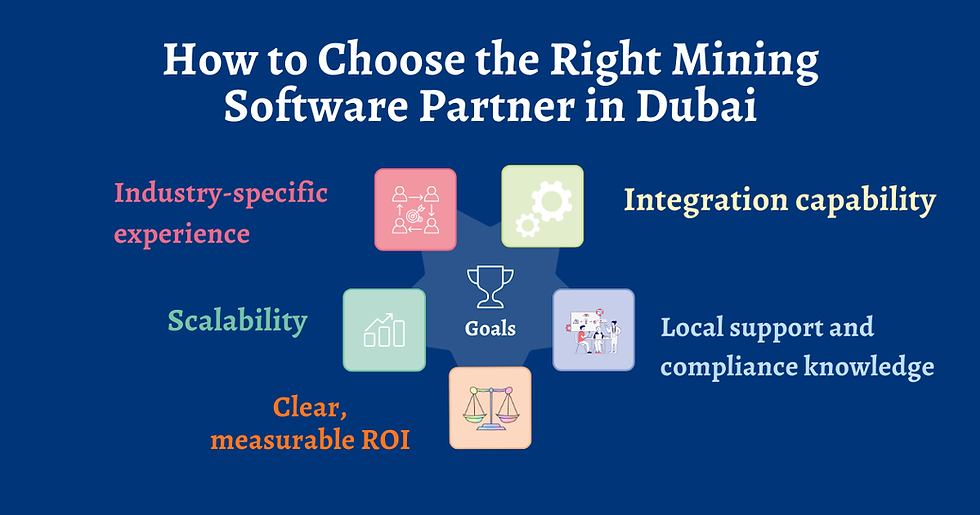
Not every software vendor understands mining, and that distinction matters more than it might seem. Here's what to actually evaluate before signing a contract:
Industry-specific experience — a Mining Software Development Company Dubai should be able to show real mining deployments, not just generic ERP or IoT projects repackaged for a new sector.
Integration capability — the platform needs to connect with your existing equipment sensors, SCADA systems, and financial software rather than forcing a costly rip-and-replace.
Scalability — Mining Management Software should work for a single site today and scale across multiple operations as the business grows.
Local support and compliance knowledge — a partner familiar with UAE regulatory and reporting requirements saves significant time during implementation.
Clear, measurable ROI — ask for real numbers on uptime improvement, cost savings, or safety incident reduction from comparable past projects, not just feature lists.
Getting this evaluation right up front is what determines whether your AI investment pays for itself in months or turns into an expensive, half-used system.
It's also worth being direct with any potential partner about your existing infrastructure limitations, whether that's remote site connectivity, legacy equipment from multiple manufacturers, or a workforce still building familiarity with digital tools. A partner worth working with will treat these constraints as design inputs to plan around, not reasons to sell you a bigger, more complicated platform than your operation actually needs right now. The right-sized solution today, built to scale later, almost always outperforms an oversized system that takes years to fully adopt.
What a Mining Software Rollout Actually Looks Like
Understanding the applications is one thing — knowing what the actual implementation journey looks like helps set realistic expectations before you start.
Most successful projects begin with a discovery phase, where the software partner spends time understanding your specific sites, equipment mix, existing systems, and biggest operational pain points. This step matters more than it might seem — a generic platform forced onto a mine with its own unique geology, equipment vendors, and workflows rarely delivers the promised ROI. A discovery phase built around your actual operation is what separates a platform that gets used every day from one that quietly gets abandoned after six months.
From there, most rollouts move into a pilot phase focused on a single high-impact use case. Predictive maintenance for one critical equipment class, or route optimization for the haul fleet, are common starting points because they're contained enough to implement quickly while still producing measurable, defensible results. This pilot phase typically runs for a few months, giving the team enough operational cycles to validate that the AI models are producing accurate, useful predictions rather than noise.
Once the pilot proves its value, the natural next step is expansion — rolling the same approach out across additional equipment categories, additional sites, or additional operational areas like safety monitoring or energy management. This is also usually when the ERP-style integration layer comes into play, connecting the individual AI applications into one unified operational dashboard rather than a collection of standalone tools.
Throughout this entire process, training and change management run in parallel with the technical build. Operators, maintenance staff, and site supervisors need to understand not just how to use the new dashboards and alerts, but why the system is making the recommendations it makes. Skipping this step is one of the most common reasons AI rollouts underperform — the technology works, but the team never fully adopts it into daily decision-making.
A typical mining AI rollout starts with a discovery phase, moves into a focused pilot on one high-impact use case, then expands site-wide with integrated ERP-style dashboards and ongoing team training.
Why Choose Sisgain Technologies
Sisgain Technologies builds AI-powered mining software solutions designed specifically for the operational realities of mining companies across the UAE and beyond. Rather than offering off-the-shelf tools, the team works directly with mining operators to build platforms around their actual equipment, sites, and workflows.
Here's what sets Sisgain apart:
Proven AI and automation expertise across predictive maintenance, fleet optimization, and safety monitoring, built on the same automation experience the company applies as a trusted Software Development Company in Dubai serving multiple industries.
End-to-end custom development — from data integration and digital twin modeling to full ERP-style production dashboards, tailored to each mine's specific processes rather than forcing a generic template.
Seamless integration with existing equipment sensors, legacy systems, and third-party platforms, minimizing disruption during rollout.
Regional presence and support, with a hands-on understanding of UAE compliance, reporting, and operational standards.
Cross-industry AI depth, drawing on broader AI Automation Services Dubai work and experience delivering Industrial AI Modern-Industries solutions across manufacturing and logistics, which strengthens how Sisgain approaches complex mining automation challenges.
Transparent, ROI-focused delivery — every engagement starts with a clear plan for measurable outcomes, not just technology for its own sake.
If your mining operation is ready to move from manual processes to a connected, AI-driven platform, Sisgain Technologies is built to make that transition smooth, measurable, and genuinely profitable.

Conclusion
Mining is one of the last major industries to fully embrace digital transformation — and that's exactly why the opportunity is so significant right now. UAE mining companies that invest in AI-powered mining software solutions today are positioning themselves for lower costs, safer sites, and faster decision-making, well ahead of competitors still relying on manual processes and disconnected systems.
The technology is proven, the ROI data is public, and the path to adoption doesn't have to be disruptive. What matters most is choosing a development partner who understands mining operations as deeply as they understand AI.
Whether you're running a single site or managing investments across several mineral projects, the operators who move first on AI-driven automation are the ones who'll be setting the efficiency benchmark the rest of the industry has to catch up to. The technology gap between manual and AI-powered mining is only going to widen from here — the question isn't whether to make the shift, but how soon you start.
Ready to bring AI-powered automation to your mining operations? Talk to Sisgain Technologies about building a mining software solution tailored to your site, your equipment, and your goals.
FAQs
1. What is mining software, and why does my company need it? Mining software is a digital platform that manages exploration, production planning, equipment, and safety data in one place, using AI to automate decisions that used to require manual analysis. Companies need it to cut costs, reduce downtime, and stay competitive as operations scale.
2. How much does custom mining software cost in the UAE? Cost depends on scope — a single-module tool like predictive maintenance costs far less than a full ERP-style platform covering production, safety, and finance. Most providers offer a phased approach so you can start small and expand based on proven results.
3. Can AI mining software integrate with our existing equipment? Yes, in most cases. A good development partner builds integration layers that connect to existing sensors, SCADA systems, and legacy software rather than requiring a complete hardware replacement.
4. How long does it take to implement AI-based mining software? A focused pilot, such as predictive maintenance for one equipment category, can often go live within a few months. Full-scale, multi-site ERP integration typically takes longer and is best rolled out in planned phases.
5. Is AI mining software only for large mining companies? No. Modular, scalable platforms mean small and mid-sized operators can start with one high-impact use case, like fleet optimization or safety monitoring, and expand as the business grows.
6. What kind of data do we need before starting an AI mining project? You don't need perfect data to begin, but you do need reasonably consistent equipment, production, and geological records. Most implementation projects start with a data audit to identify gaps and standardize formats before the AI layer is built on top.
7. Will AI mining software replace our current workforce? No — it shifts roles rather than eliminating them. Operators and engineers move from manual monitoring and reporting toward oversight, exception-handling, and strategic decisions, while the system handles routine data processing and alerts.


Comments