IoT Software Development Company in Dubai: Complete Guide to Smart IoT Solutions for UAE Businesses (2026)
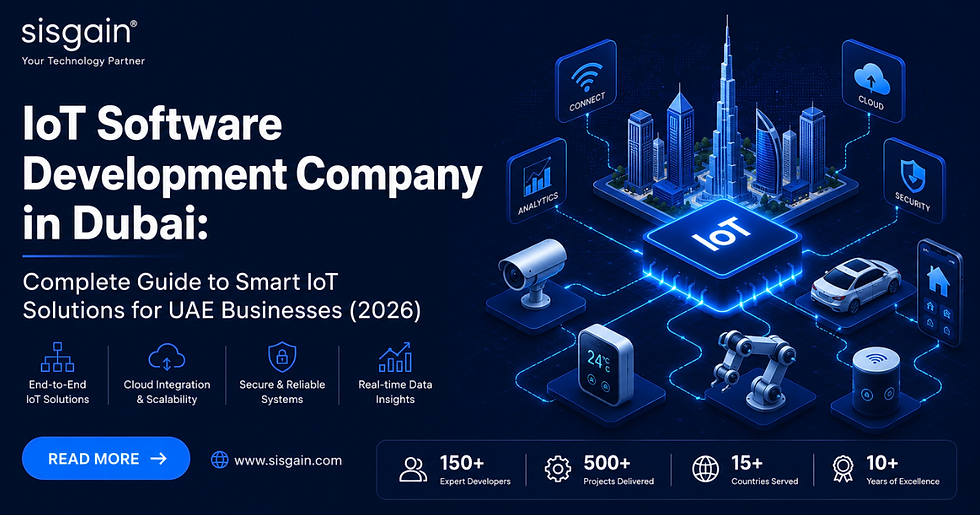
Dubai isn't waiting for the future of connected business — it's already building it. Hospitals track patient vitals in real time. Logistics fleets reroute themselves before a delay even happens. Retail shelves restock before they go empty. None of this runs on luck. It runs on software.
That's where a capable IoT Software Development Company in Dubai comes in. The sensors and devices get the attention, but the real value sits in the software layer that turns raw data into decisions — dashboards, cloud platforms, APIs, and AI models working together behind the scenes.
Smart Dubai's push toward a fully connected city, paired with 5G rollouts and
government-backed AI strategy, has made custom IoT software a competitive necessity rather than a nice-to-have. Businesses across healthcare, logistics, manufacturing, retail, real estate, and government are moving away from off-the-shelf connected gadgets and investing in software built around their exact workflows.
Demand isn't limited to one sector, either. Hospitals want remote monitoring that reduces readmissions. Freight companies want cold-chain visibility that prevents spoiled shipments. Property developers want buildings that manage their own energy consumption. Government departments want infrastructure that reports its own maintenance needs before something breaks in public. Each of these use cases needs different sensors, but they all depend on the same thing: software architecture that's built to handle real operational load, not a proof-of-concept demo.
At SISGAIN Technologies, we build that software. This guide walks through what IoT software development actually involves, why Dubai has become a serious IoT hub, and how the right technology partner can turn scattered devices into a system that actually runs your business better.
What is IoT Software Development?
IoT software development is the process of building the applications, platforms, and analytics layers that make connected devices useful. A sensor on its own just collects data. Software is what interprets that data, stores it, secures it, and turns it into an action someone can actually take.
IoT software development is the design and coding of platforms, dashboards, and analytics systems that collect data from connected devices and turn it into real-time insights and automated actions for a business.
Understanding IoT Software
A working IoT system is built from several layers that need to talk to each other without friction:
Sensors — capture temperature, motion, location, pressure, or usage data
Connected devices — the hardware that carries those sensors (machines, vehicles, wearables, meters)
Cloud platforms — store and process the incoming data at scale
Mobile applications — give teams access to live data from anywhere
Dashboards — visualize what's happening across a fleet, building, or facility
APIs — connect IoT data to your existing ERP, CRM, or business systems
AI analytics — spot patterns humans would miss and predict what happens next
How IoT Software Works
The flow is simpler than it sounds once you break it into five steps: a device captures data, a gateway transmits it, the cloud stores and processes it, an analytics layer makes sense of it, and finally a business application puts it in front of the right person at the right time. Miss any one link in that chain, and the whole system stalls — which is exactly why the software layer matters as much as the hardware.
Why Dubai is Becoming a Global Hub for IoT Innovation
Dubai didn't stumble into its IoT momentum. It built it deliberately, and the numbers back that up.
The Smart Dubai initiative set out to make Dubai the happiest and smartest city on earth, and much of that plan runs directly through connected technology — smart traffic systems, smart utilities, and digital government services. The UAE's National AI Strategy 2031 pushes that further, aiming to position the country as a global leader in artificial intelligence, with IoT data feeding many of those AI models.
Layer on the UAE's aggressive 5G rollout — among the fastest and most widely available networks in the region — and you get the low-latency backbone that real-time IoT applications actually need. Add a government that's gone almost entirely digital, from DEWA's smart grid to Dubai Municipality's smart building codes, and you have an economy where Industry 4.0 isn't a slogan on a slide deck. It's policy.
Market research from Mordor Intelligence and Statista points to double-digit annual growth in the UAE IoT market through 2030, driven heavily by smart city projects, healthcare digitization, and logistics modernization. For businesses operating in this market, that growth curve is either an opportunity to get ahead of competitors, or a gap that widens every quarter they wait.
What makes Dubai different from other IoT markets in the region isn't just the technology budget — it's the willingness of government bodies to move first. DEWA's smart grid rollout, RTA's connected transport systems, and Dubai Municipality's building automation codes all set a precedent that private enterprises are now following. When the public sector treats connected infrastructure as the default rather than the exception, it changes what customers and regulators expect from private businesses too. That shift is a large part of why so many UAE companies are now asking for custom platforms instead of retrofitting whatever hardware vendor bundle they were sold three years ago.
Why Businesses Need an IoT Software Development Company in Dubai

Hardware is easy to buy. Making it work for your specific operations is not. That gap is exactly why enterprises hire the right IoT development partner instead of stitching together generic tools themselves.
Real-Time Monitoring
Live visibility into equipment, inventory, or facility conditions — no more waiting for an end-of-day report to find out something went wrong.
Operational Automation
Repetitive manual checks get replaced with rules-based automation, freeing staff for work that actually needs a human.
Predictive Maintenance
Sensors flag wear and performance drops before a machine fails, cutting unplanned downtime and emergency repair costs.
Cost Optimization
Energy usage, fleet routes, and inventory levels get optimized continuously instead of reviewed quarterly.
Better Customer Experience
Faster deliveries, shorter wait times, and personalized service — all powered by data the business didn't have visibility into before.
Data-Driven Decision Making
Leadership stops guessing and starts deciding based on what the data is actually showing, in near real time.
Businesses need a dedicated IoT software partner in Dubai because generic IoT hardware doesn't deliver value on its own — custom software is what turns device data into monitoring, automation, and predictive insights specific to a company's operations.
IoT Software Development Services We Offer
SISGAIN Technologies delivers end-to-end IoT software built around how your business actually operates, not a generic template.
Custom IoT Software Development Dubai
Purpose-built platforms designed around your exact devices, workflows, and compliance needs — not a repackaged off-the-shelf tool.
IoT Platform Development Dubai
Centralized platforms that pull data from multiple device types into one dashboard, giving you one source of truth instead of five disconnected apps.
IoT App Development Company Dubai
Mobile and web applications that put live device data in the hands of field teams, facility managers, and executives alike.
IoT Integration Services Dubai
Connecting new IoT deployments with your existing ERP, CRM, or legacy systems, so data flows both ways without manual re-entry.
IoT Consulting Services Dubai
Strategic guidance on architecture, device selection, and rollout planning before a single line of code gets written.
Enterprise IoT Solutions Dubai
Large-scale deployments across multiple sites, built to handle the security and compliance demands of enterprise operations.
AIoT Development Company Dubai
Combining IoT data streams with AI models for predictive insights that go beyond simple dashboards and alerts.
Smart IoT Solutions Dubai
Solutions engineered for smart buildings, smart retail, and smart facility management use cases specifically.
Industrial IoT Development Dubai
Manufacturing-grade IoT for factory floors, covering machine monitoring, quality control, and production line analytics.
As an established IoT development company Dubai businesses trust, we build every solution with UAE compliance and enterprise security requirements in mind from day one — not bolted on afterward.
Industries We Serve

IoT software isn't one-size-fits-all. Each sector needs a different set of features, and generic platforms tend to fall short exactly where it counts.
Healthcare — Remote patient monitoring, smart hospital systems, and medical asset tracking that keeps expensive equipment accounted for across large facilities. This overlaps closely with our work in Healthcare Software Development Dubai, where IoT sensors feed directly into patient management systems.
Logistics & Fleet — GPS tracking, cold chain monitoring for temperature-sensitive shipments, and predictive maintenance that keeps vehicles on the road instead of in the shop. Our team also builds this into broader engagements through our Logistics Software Development Company Dubai practice.
Manufacturing — Smart factory floors, predictive maintenance on production equipment, and quality monitoring that catches defects before they reach the customer.
Real Estate — Smart buildings with automated climate control, energy optimization, and centralized facility management dashboards.
Retail — Smart shelves that track stock levels automatically, customer analytics from foot traffic patterns, and inventory automation that reduces stockouts.
Energy & Utilities — Smart meters, grid monitoring, and consumption analytics that support the UAE's broader sustainability goals.
Across every one of these sectors, the pattern repeats itself: the sensor hardware is largely commoditized, but the software that decides what to do with the data is where companies actually differentiate. A logistics operator with cold chain sensors and no analytics layer just has a lot of temperature logs. The same sensors paired with predictive software can flag a failing refrigeration unit two days before it spoils a shipment. That difference is entirely a function of the software, not the device.
Latest IoT Trends Transforming Dubai Businesses
The IoT landscape isn't static, and 2026 is shaping up to be a turning point for several converging trends.
AIoT (Artificial Intelligence + IoT) is moving from buzzword to baseline — sensors paired with machine learning models that don't just report data but predict what happens next. Digital twins let facility managers simulate a building or production line virtually before making costly physical changes. Edge computing is cutting latency by processing data closer to the device instead of routing everything through a distant cloud server, which matters enormously for time-sensitive applications like autonomous logistics.
Private 5G networks are giving large enterprises dedicated, secure connectivity independent of public carrier networks. Dubai's smart city projects keep expanding, from traffic management to public safety systems. Connected healthcare continues to grow post-pandemic, with remote monitoring now a standard offering rather than an experiment.
Autonomous logistics — self-optimizing delivery routes and warehouse robotics — is picking up pace across the region's ports and fulfillment centers. Blockchain for IoT security is gaining traction as a way to secure device-to-device communication against tampering, an area closely tied to our own Private blockchain development services Dubai. And sustainability-driven smart energy systems are becoming standard in new commercial developments, aligned with UAE Net Zero 2050 commitments.
Common Challenges in IoT Development
Every IoT deployment runs into friction somewhere. The difference between a project that scales and one that stalls usually comes down to how these challenges get handled upfront.

Most of these aren't hardware problems. They're software architecture problems — which is exactly why the choice of development partner matters more than the choice of sensor brand.
Why Custom IoT Software is Better Than Off-the-Shelf Solutions
Generic IoT platforms look tempting on price, but they tend to hit a ceiling fast once a business tries to scale or differentiate.
Custom IoT | Generic IoT |
Scalable | Limited |
Secure | Basic |
Industry-specific | Generic |
AI Ready | Limited |
Easier Integration | Difficult |
Competitive Advantage | Standard Features |
Custom IoT software development Dubai gives businesses room to grow, adapt to industry-specific regulations, and build features competitors on the same generic platform simply don't have access to. It costs more upfront. It almost always costs less over three years.
How We Develop IoT Software
Our process runs through nine stages, each one building on the last: Discovery to understand your operational goals, Architecture planning for scalability and security, Hardware Integration with your existing or new devices, Software Development of the core platform, Cloud Integration for storage and processing, AI Analytics to surface predictive insights, Testing across real-world conditions, Deployment with minimal operational disruption, and Managed Support to keep the system running and improving long after launch.
Essential Features of Enterprise IoT Software
An enterprise-grade IoT platform needs more than a pretty dashboard. Look for device management, remote monitoring, OTA (over-the-air) updates so devices stay current without a site visit, role-based access to control who sees what, AI analytics and predictive maintenance to get ahead of failures, API integrations with existing business systems, multi-cloud support to avoid vendor lock-in, edge computing for low-latency processing, data visualization, alerts and notifications, and blockchain security for tamper-proof device communication.
Skip any of these, and you're not buying an enterprise platform — you're buying a demo that won't hold up at scale.
Why Choose SISGAIN Technologies in Dubai
SISGAIN Technologies has built its reputation by delivering enterprise-grade software solutions that perform reliably in real-world production environments—not just in demonstrations. Here's what sets our approach apart:
UAE-focused expertise — We develop solutions aligned with local compliance requirements, infrastructure, and business needs from day one.
Industry-specific solutions — Healthcare, logistics, manufacturing, real estate, retail, and other industries receive tailored development strategies.
AI-powered innovation — Every solution is designed with AI and predictive analytics capabilities to help businesses make smarter decisions.
Enterprise-grade security — We implement Zero Trust architecture, advanced encryption, and blockchain-backed security wherever required.
Cloud-native architecture — Our scalable solutions grow with your business without requiring costly redevelopment.
Agile delivery — We provide working software early and continuously improve it through short, iterative development cycles.
Dedicated support — Our experienced team understands your platform and provides consistent, long-term technical support.
End-to-end development — From strategy and consulting to development, deployment, and ongoing maintenance, we manage the complete software lifecycle.
Managed services — We offer continuous monitoring, updates, performance optimization, and proactive support to keep your solution running at its best.
In practice, this customer-centric approach ensures every project is tailored to unique business requirements. For example, a logistics company requiring cold chain visibility has very different operational needs from a hospital managing connected medical equipment. Our discovery and planning process identifies these differences early, allowing SISGAIN Technologies to design the right architecture from the beginning. This minimizes costly rework, accelerates deployment, and delivers a solution that aligns with your business goals from day one.
Future of IoT in Dubai
The next phase of Dubai's IoT journey looks less like isolated projects and more like connected infrastructure at city scale. Expect deeper investment in AIoT, autonomous infrastructure, and expanded smart city rollouts across transport and utilities.
Connected healthcare will keep expanding beyond hospitals into home care. Green buildings and industrial automation will lean harder on IoT to hit sustainability targets. Digital twins, edge AI, and robotics will move from pilot programs into standard operating procedure for larger enterprises.
Analysts tracking the region's tech spend expect the UAE's broader IoT market to keep compounding through the decade, with government-backed smart city budgets acting as a multiplier for private-sector adoption. Businesses that build the software foundation now will be the ones positioned to take advantage of that growth, rather than playing catch-up in 2028.
There's also a quieter shift happening beneath the headline trends: interoperability. Early IoT deployments in the region often ran as isolated silos — one platform for building management, a separate one for fleet tracking, another for energy monitoring, none of them talking to each other. The next few years will likely see enterprises consolidating around fewer, better-integrated platforms rather than adding more disconnected point solutions. That consolidation favors businesses that invested in properly architected, API-first software from the start over those that bought whatever hardware bundle came with a proprietary app attached.

Conclusion
IoT has moved past the experimental phase in Dubai. It's now infrastructure — the layer that real-time monitoring, predictive maintenance, and automated operations all run on top of. Businesses that treat it as just another hardware purchase tend to end up with disconnected devices and no real return. Businesses that invest in the right software behind those devices end up with a system that actually improves how they operate.
Secure, scalable, AI-powered IoT platforms aren't a future consideration anymore — they're what separates companies scaling efficiently from ones stuck patching together generic tools. The businesses moving on this now will be the ones with a real head start by the time the rest of the market catches up.
Contact us today for a free consultation and accelerate your IoT journey.
Frequently Asked Questions
What does an IoT Software Development Company in Dubai do?
It designs and builds the software layer — platforms, dashboards, APIs, and analytics — that turns data from connected devices into usable business insights and automated actions.
How much does IoT software development cost in Dubai?
Cost depends on device count, integration complexity, and whether AI analytics are included. Small pilot projects can start in the tens of thousands of dirhams, while enterprise-wide deployments run significantly higher. A consultation gives you an accurate estimate based on your specific scope.
How long does IoT software development take?
A focused pilot project typically takes 8-12 weeks. Full enterprise deployments across multiple sites can run 4-9 months, depending on integration complexity.
Which industries benefit most from IoT?
Healthcare, logistics, manufacturing, retail, real estate, and energy see the fastest returns, largely because they generate high volumes of operational data that's easy to act on once it's visible.
What is AIoT?
AIoT combines Artificial Intelligence with IoT devices, allowing systems to not just report data but predict outcomes and trigger automated responses.
What is Industrial IoT?
Industrial IoT (IIoT) applies connected sensors and software specifically to manufacturing and industrial environments — think production line monitoring, quality control, and predictive maintenance on heavy machinery.
Is IoT secure?
IoT security depends entirely on how the software is architected. Zero trust frameworks, encrypted device communication, and role-based access controls are what actually keep a system secure — not the devices themselves.
Why choose custom IoT software?
Custom software scales with your business, fits your specific industry regulations, and gives you features competitors using generic platforms don't have.
Do you provide IoT consulting services?
Yes. We offer standalone IoT consulting for businesses that want architecture and strategy guidance before committing to full development.
Can IoT integrate with ERP and CRM?
Yes. API-based integration is one of the core services we provide, connecting IoT platforms with existing ERP, CRM, and legacy business systems so data flows in both directions.


Comments